Iran is bounded on the north by Armenia, Azerbaijan, Turkmeinstan and by the Caspain Sea lying between them. On the east is bounded by Afghanistan and Pakistan on the west by Iraq and Turkey and on the south by the gulf and the Indian Ocean. It consists of a plateau surrounded on almost every side by mountains. Of these the Zargos Mountains extend from the north west of the eastern part of the gulf and from there eastwards into Baluchistan. Along the southern edge of the Caspain Saea are the narrower but equally high Elburz Mountains. The interior of Iran is covered partly by a salt swamp called kavir and partly by a region of loose stones or sand called dasht while most of the country’s cultivation is on stretches of land around the foothills of the mountain ranges. Most of the kavir is too desolate and dangerous for exploration. Iran’s climate ranges from as high as 55 degrees c in the summer in the interior to as low as minus 20 degrees c in some areas in winter. The Caspian Sea area, the most densely populated in the country is hot and humid while most of the country is arid.
Iran has the holy shrine of Imam Ali al-Ridha.
Population
60 million (1995)
Area
1,648,195 sq. km
Ethnicity/ Race
Persian 51%, Azeri 24%, Gilaki and Mazandarani 8%, Kurd 7%, Arab 3%, Lur 2%, Baloch 2%, Tu
Major Languages
Persian and Persian dialects 58%, Turkic and Turkic dialects 26%, Kurdish 9%, Luri 2%, Bal
Religion
Shi'a Muslim 89%, Sunni Muslim 10%, Zoroastrian, Jewish, Christian, and Baha'i 1%
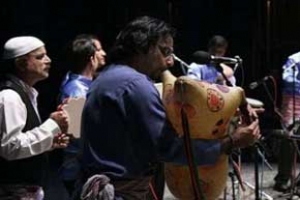
The Morvarid-e Lian band from the southern Iranian city of Bushehr will perform the Zar rite at Algeria+s International Cultural Festival of Folk Dance, which will be held from July 12 to 18 in Sidi Bel Abbes. The Zar rite, commonplace in southern Iran, is a legacy from slavery as it was performed by African slaves who were brought to southern Iran. They performed it on weekends in order to gain energy to enable them to bear the burden of bondage for the rest of the week, MNA reported. Over time, ordinary people also joined in their musical rite comprising ecstatic dance with dammam (tom-tom) playing. Today, Zar is mostly performed by workers in a group named ahl-e hava, which is conducted by a leader called a babazari. “The festival invited us due to communalities existing between Bushehr and African music,” the leader of Lian band Mohsen Sharifian explained in a press release. Thirty bands from different countries will participate at the festival to introduce their country and their culture through their performances and rhythmical movements, he added.