|
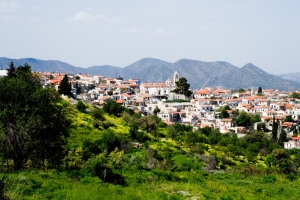
This is the mountainous area of Larnaka district, characterized by white earth dotted with olives and carobs. The low undulating hills hide picturesque villages for the discerning traveler to discover. They include Lefkara, Kato Drys, Lageia, Ora, Odou, Agioi Vavatsinias and Vavatsinia.
The largest and probably the best known is Lefkara, famous for its local face and its filigree silverware. Divided into Upper (Pano) and Lower (Kato) Lefkara, is an architecturally protected village with picturesque houses with stone walls, red tiled roofs and inner courtyards.
Of the different types of traditional embroidery in Cyprus, Lefkara lace is the most famous with a world-wide reputation. This form of needlework has survived and flourished in almost its original form from the period of Venetian rule of Cyprus in the 16th century and is made primarily in the village of Lefkara, which was the principal summer resort of wealthy Venetians. The lace is made using mercerized cotton thread and with a technique that involves counting the threads of the fabric, resulting in strictly geometrical shapes. Sights include the Museum of Traditional Embroidery Silver-smithing, housed in a beautiful old house (Patsalos Residence), whose exhibits include some exquisite examples of the lace for which the village is famous, and the Church of Archangel Michael in Kato Lefkara, a single-domed 12th century Byzantine church with frescoes.
Elsewhere the Rural Museum at nearby Kato Drys village, notable for its local architecture, is well worth a visit. A little further the convent of Agios Minas has a dominant position over the area, with castle like architecture; its nuns specialize in icon painting. Continue driving through the hills to discover an area off the beaten track with villages which have kept their traditional charm. The region is ideal for mountain biking and for angling in the Lefkara dam.
The area also has small hotels and agrotourism establishments for overnight stays and a number of good restaurants.
|